Efest batteries and chargers, what you need to know
Purple cells turn up in almost every vape shop, and the name Efest comes up as soon as anyone mentions batteries or chargers. But how good is the brand really? Its wraps display high current ratings, its chargers range from compact two-bay units to models with a screen, and counterfeits circulate. Before buying, it pays to know what you are holding in your hand, and how to read it.
Efest, the maker behind the purple cells
Efest is a brand of Shenzhen Fest Technology, based in Shenzhen, China. It designs and distributes rechargeable lithium-ion cells in the 18650, 26650, 21700 and 18350 formats, along with chargers, cases and carrying accessories. Its range is aimed first at vapers, and also at torch users.
Like almost every brand in the sector, Efest does not build its cells from scratch. It selects cells produced by major electronics manufacturers, dresses them in its purple wrap and sells them under its own model names.
This practice, known as rewrapping, is common and perfectly acceptable as long as the stated ratings are honest. It does mean that the wrap tells you who sells the cell, not who made it, which is why the figures printed on it deserve a careful look.
Reading the label on an Efest battery
The wrap of an Efest cell puts a capacity and a current rating in large print. Both figures need careful reading, because the most visible one is not always the one that matters for your safety.
The headline figure is often the pulse current
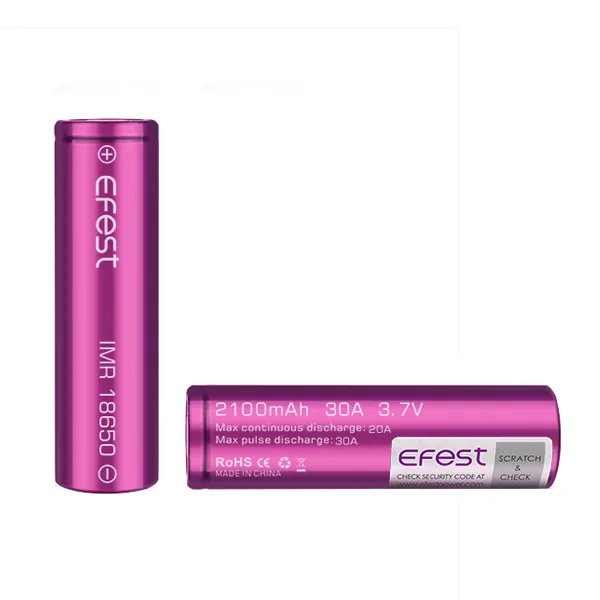
Take the brand’s IMR 18650 2100 mAh cell marked 30A. In small print on the wrap there are two values, 20 A of continuous discharge and 30 A of pulse discharge.
The 30A on the label is therefore the maximum current the cell can handle for a few seconds, not what it can supply constantly. To match a cell to your mod, go by the continuous figure and leave the pulse number aside.
IMR and what the chemistry means
IMR denotes a lithium manganese chemistry, known for delivering high currents while staying stable. Recent ranges also include INR cells (nickel manganese cobalt), which offer more capacity. In both cases they are unprotected cells, with protection handled by the electronics of the mod.
The formats on offer
The catalogue covers the 18650 from 1,600 to 3,500 mAh, the 26650 up to 4,200 mAh, and the 21700 for modern mods. The 18350, which is very short, powers compact tube mods. It drains quickly and calls for an even stricter reading of its continuous current.
The choice between these formats depends only on the bay in your kit. Our guide to the 21700 battery explains what separates one model from another within the most common format.
Efest chargers, Slim K, LUC and Pro C4
Chargers make up the other half of the catalogue, and they are often how people first come across the brand. They fall into three families, according to the number of bays and the amount of information on display.
Slim K1 and K2 at entry level
The Slim K1 (one bay) and K2 (two bays) are compact USB-powered chargers. They charge most cylindrical formats, with a simple LED that changes colour when charging ends. Their strengths are simplicity and size, their weakness the lack of any voltage display.
With a dual-battery mod, a multimeter check at the end of charging is then the only way to confirm that both cells finished at the same level.
LUC and Pro C4 with several bays and a screen
The LUC series (V2, V4, V6, V8) and the Pro C4 add a screen showing the voltage and progress of each cell, with adjustable charge current on some models. For a dual-battery mod, a charger like this shows whether both cells end at the same voltage, something a basic charger cannot tell you.
What an Efest charger will not do
No charger can restore a damaged cell. A cell that stays at low voltage after a full charge, or that runs unusually hot in the charger, should be taken out of service. The manufacturer also advises never leaving a cell in the charger for more than 24 hours.
Checking that an Efest product is genuine
Every cell and charger from the brand carries a scratch-off label with a 16-digit authentication code, to be entered on the Product Verify page of the official website. An unknown code, or a new product with no anti-counterfeit label, should be reported to the seller.
This check takes a minute and is worth doing every single time. A counterfeit copies the purple wrap but not the original cell, and its real ratings are unknown. Buy from an identifiable specialist retailer rather than an anonymous marketplace seller.
Using an Efest battery with care
The manufacturer’s instructions leave no room for doubt, and the warranty covers no incident caused by misuse. They come down to a handful of simple habits.
Never carry a bare cell in a pocket, where contact with keys or coins causes a short circuit, and use a dedicated case instead. Do not mix cells of different brands, models or ages in the same mod, and take the cells out of any kit you are not using.
A cell that runs unusually hot, swells, discolours or gives off a smell must not be used or charged again. It goes to a battery collection point. A charger that has been modified, or whose cable is damaged, gets replaced rather than repaired.
The manufacturer also states that its warranty does not cover a cell used outside the currents and temperatures shown on its data sheet. A mod set beyond what the cell can deliver continuously therefore voids any claim, on top of the immediate risk it creates.
Frequently asked questions
Efest or Samsung, Sony and Molicel, which should I choose?
Cells sold under the original manufacturer’s name come with a detailed data sheet, which makes comparison easier. An Efest cell does the job as long as you go by its continuous discharge rating and have checked that it is genuine.
Can I take Efest spare batteries on a plane?
Yes, in cabin baggage only and never in the hold. Each spare cell has to be protected against short circuits, which an individual battery case does well.
Can I charge an Efest battery inside the mod?
Yes, if the mod has a charging port. An external charger is still the better choice for a dual-battery mod, because it lets you check the balance between the two cells.
Will an Efest 18650 work in a 21700 mod?
With the adapter supplied by the mod maker, yes. Battery life will be shorter than with a 21700, and the maximum current depends on the 18650 model you pick.
What should I do with an Efest battery at the end of its life?
Take it to a battery collection point, ideally with its terminals taped over. Never throw it away with household rubbish.
Efest is a sound choice once you can read the label
An Efest cell is neither better nor worse than any other rewrap. Everything depends on the cell hidden under the wrap and on how you read its ratings. Go by the continuous current, check the authentication code, charge on a charger that shows voltage, and carry your cells in a case.
With those habits in place, the purple cells earn their spot in a vaper’s kit, alongside everything else that keeps a well-maintained setup running from one day to the next. Read the small print first and Efest becomes a straightforward choice.
Related reading
Editorial content for adults. Vaping products are not sold to under-18s in the United Kingdom, and nicotine is a highly addictive substance. Brand and model names appear for information only, not as a buying recommendation.