21700 battery, how to choose and use it well

Your mod asks for a 21700 cell, and the listings seem to argue with each other. One shows 4,000 mAh, another 30 A, a third claims 45 A for what looks like the same model. Which figure actually matters? A poor choice rarely shows on day one. It shows later, as short battery life, a cell that runs hot, or worse. This guide takes the 21700 battery from the very beginning, without needless jargon.
What a 21700 battery is and why it is replacing the 18650
A 21700 battery is a rechargeable lithium-ion cell measuring 21 mm across and 70 mm long, and the final zero in the name marks its cylindrical shape. An 18650, by comparison, measures 18 mm by 65 mm. The 21700 is only slightly larger, yet it holds noticeably more active material.
In practice that extra size brings more capacity, often 3,000 to 5,000 mAh, along with more comfortable discharge current at the same capacity. That is why most recent mods with a removable cell are built around this format, usually with an adapter so they still accept an 18650.
The naming logic is worth keeping in mind, because it applies to every cylindrical format. The first two digits give the diameter in millimetres, the next two the length. Once you know that, a listing that quotes nothing but a number already tells you whether the cell will fit your mod.
Reading 21700 battery ratings without getting caught out
Three values appear on the wrap or the data sheet. Capacity, discharge current and voltage have to be read together, never in isolation, and the one a seller puts up front is not always the one that matters most.
Capacity in mAh
Capacity, measured in milliamp-hours, sets the theoretical battery life. A 4,000 mAh cell lasts longer than a 3,000 mAh cell at the same draw. A high capacity figure, though, nearly always comes at the expense of maximum current, because a cell cannot be both very long-lasting and very powerful.
Continuous discharge current
Continuous discharge current, often shown as CDR, is the current a cell can deliver constantly without overheating. It is the value that counts for your safety. Many wraps print a pulse figure in large type instead, and that one only holds for a few seconds.
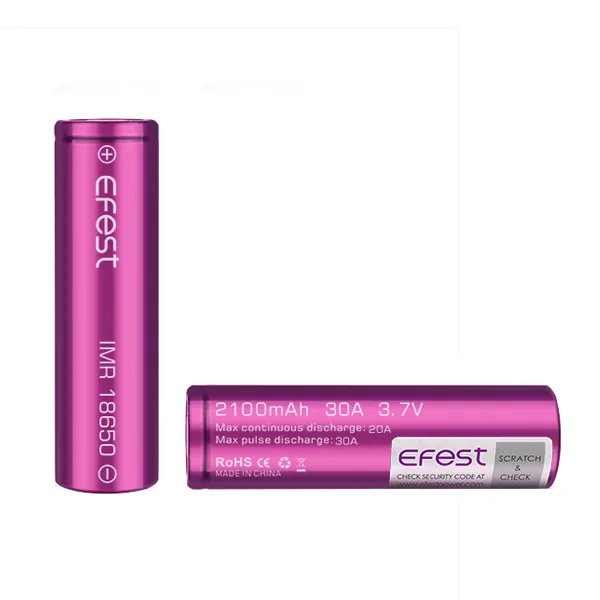
A label reading 30 A can therefore hide a continuous rating of 20 A. Always look for the word continuous on the data sheet published by the cell manufacturer, not on the retailer’s listing.
Nominal voltage and cut-off voltage
A 21700 is rated at 3.6 to 3.7 V nominal and 4.2 V when fully charged, and it falls to around 2.5 V when empty. A regulated mod usually cuts off before that point, around 3.2 to 3.3 V, to protect the cell. On a mechanical mod nothing stops you, so keeping an eye on voltage becomes your job.
Choosing a 21700 battery for the way you vape
The right cell depends on the power you really use, not on the maximum printed on the mod. A simple calculation settles most cases, since the current drawn equals voltage divided by resistance. With a 0.2 ohm coil at 4.2 V the cell delivers 21 A, while at 0.5 ohm it delivers only 8.4 A.
Tight draw and low power
Below 30 W, with a coil above 0.8 ohm, the current demand stays low. Favour capacity here. A cell of 4,000 to 5,000 mAh rated at 15 to 20 A continuous suits this use perfectly and gives you the longest battery life.
Airy draw and high power
Above 60 W, or below 0.3 ohm, the current climbs quickly. Pick a cell rated for at least 30 A continuous, even if it means giving up some capacity. The Samsung 30T, for example, is rated at 3,000 mAh and 35 A continuous, which makes it the textbook reference for this profile.
Between those two profiles, run the same calculation with the coil you actually use, then keep a comfortable margin under the continuous rating. A cell that works close to its limit every day ages faster and runs warmer than one that has room to spare.
Dual-battery mods and the pairs rule
A dual-battery mod needs two identical cells, meaning the same model, ideally the same batch, bought and charged together and never split up. Two cells of different ages drift out of balance, and the weaker one ends up pushed beyond its limit. Specialist brands such as Efest batteries sell cells in pairs for exactly this reason.
Charging a 21700 battery properly
A dedicated external charger for lithium-ion cells remains the most reliable option. It shows the voltage of each cell, stops at 4.2 V and flags a faulty cell. Set the charge current to the value recommended by the cell maker, usually 1 to 2 A for a 21700.
Charging through the mod’s USB port will do in a pinch, but it heats the cell more and does not balance two cells. Either way, never leave a cell charging unattended for long, and take it off the charger once it is full rather than forgetting it there overnight.
Before each charge, glance at the wrap and at the voltage reading. A cell that arrives far lower than its twin, or that already feels warm before charging has started, is telling you something worth checking before you go any further.
Carrying and storing a 21700
Out and about, a cell travels in a hard case or a plastic box, on its own. A coin or a key touching both terminals causes an instant short circuit, and the wrap only protects the cell while it is intact.
Flying adds one fixed rule. Spare cells travel in cabin baggage only, never in the hold, and each one has to be protected against short circuits, which is exactly what a proper battery case does.
For storage over several weeks, leave the cell at half charge, around 3.7 V, somewhere dry and at room temperature. A cell stored full or flat ages faster. Check the wrap each time you handle it, since a tear near the positive terminal can be fixed with new heat-shrink, otherwise the cell should be retired.
When to replace a 21700 battery
No cell lasts forever. Battery life that drops sharply, a cell that heats up at rest, or one that loses voltage far faster than its twin are all signs that the end is near. Swelling, an unusual smell or a damaged wrap that has not been replaced mean you stop using it at once.
A used cell goes to a battery collection point, never in household rubbish. Covering the terminals with insulating tape before dropping it off stops it shorting against other cells in the bin.
Frequently asked questions
Can I use an 18650 in a mod designed for a 21700?
Yes, with the adapter that most mod makers supply. The reverse is impossible, because a 21700 is too wide for an 18650 bay.
What is the difference between a 20700 and a 21700?
The 20700 is 20 mm in diameter instead of 21. The two formats perform in a similar way and often fit the same bay, but the 21700 is far more widespread today.
Is a protected 21700 better for vaping?
No. Protected cells include a circuit that adds a few millimetres of length and limits current, so they do not fit in a mod and are not designed for vaping. Choose an unprotected IMR or INR cell and let the mod handle protection.
How many charge cycles does a 21700 last?
Cell makers generally quote a few hundred full cycles before a noticeable loss of capacity. High-power use and fast charging shorten that figure.
Do I need a specific charger for this format?
Any lithium-ion charger whose bays take a 70 mm cell will do. Check this before buying, as some older chargers designed for the 18650 will not close on a 21700.
Before you buy a 21700 battery
Choose a 21700 battery on its continuous discharge current first, its capacity second, and never on the biggest number on the wrap. Buy an identified brand from a specialist retailer, in a pair if your mod takes two, and keep a dedicated case for carrying.
These habits take a minute and help you avoid most battery-related incidents. They apply to every removable cell format, whatever kit you vape with, and they are the quickest way to get the best out of any 21700 battery you own.
Related reading
- Vape case, carrying your kit within UK rules
- Vape on a plane, what the UK rules say
- Vape filter, upkeep and replacement
Editorial content intended for adult readers. Vaping products are not for sale to under-18s in the United Kingdom, and nicotine is a highly addictive substance. This guide gives general information on handling batteries and is not a buying recommendation.